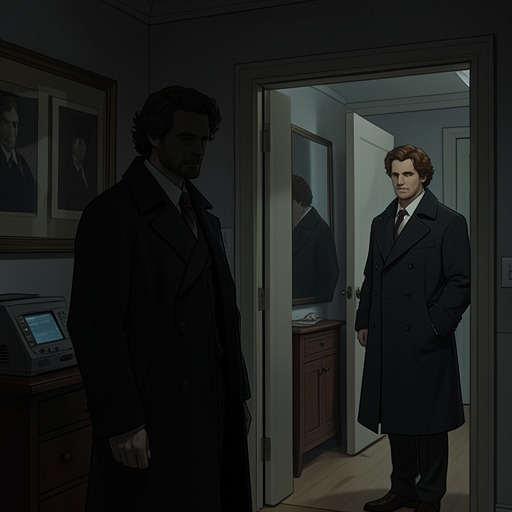
“I am a spy, a sleeper, a spook, a man of two faces”
The Sympathizer“I am a spy, a sleeper, a spook, a man of two faces” is The unnamed narrator’s opening declaration and the compact formula through which he introduces himself. It joins his covert role to a divided way of thinking: he can see an issue from both sides, a capacity he first considers a virtue but already recognizes may possess him as much as he uses it.
The Opening Declaration
The phrase appears at the start of The unnamed narrator’s confession, before he describes himself as able to see any issue from both sides. Its sequence moves from names for covert identities to the image of two faces, making divided allegiance and divided appearance part of the same self-portrait. He does not present himself as a misunderstood mutant; instead, he calls this doubleness his only possible talent, while admitting that it is minor and involuntary.
Talent and Hazard
The narrator’s account turns on a distinction between a talent he can use and a capacity that uses him. Seeing both sides can seem like a virtue, but because he cannot stop doing it, it also becomes a hazard. The expression therefore names more than deception or a public disguise: it introduces an unsettled relationship between the narrator and his own divided perspective. At the point when the confession begins, he has not yet understood the full danger of that perspective.
The Confessional Frame
The declaration is addressed to The Commandant as part of a confession written in confinement. The unnamed narrator connects his villa room during the decisive April of the war to his room in the camp, which he identifies as an isolation cell; in both places, he values privacy as a condition for writing. That frame gives the opening self-description a double force: it is an account of how he understands himself and the beginning of a statement made under the authority of a captor.